Monday, June 25, 2012

Human Scale and Human Pace: Thinking about Everyday Technology


Gary Larson is probably my favourite cartoonist. He appeals to me because of his eye for the bizarre and the off-beat: from cows conscious that they are “without opposable thumbs” watching helplessly as their telephone(!) rings, to the Lone Ranger discovering in retirement that when Tonto referred to him as “Kemosabe” for all those years, he was actually calling him “horse’s rear end”. Occasionally, as philosopher Albert Borgmann notes on the same cartoon I am about to describe, the cartoonist is able to make explicit in an absurd way our tacit, faulty assumptions about cultural commonplaces. The Far Side cartoon by Larson I have in mind features, from memory, two parents sitting on a couch with their two children lying on their stomachs on the floor with their chins propped up on their hands, all of them facing an empty lounge room corner. The caption reads: “The family in the days before television.”

The scenario is clearly and deliciously absurd and yet it captures to a large degree the naïve way we often think about the presence or absence of ‘everyday technology’. We tend to treat technologies, particularly the new electronic devices we buy—personal computers, DVD players, VCRs, mobile telephones—as mere items that fill the empty spaces in our lives. Many of us tend to think that a new technology merely adds new capacities to our lives, improves sound or picture quality, promotes ease of communication, increases speed of tasks, enables access to information and entertainment, and so forth. That may well be the case. But there is a whole lot more happening when modern technology is introduced into our lives, even when it is done so with our full consent.

As I ‘write’ this on my computer—yes, yes, I know, I’m using a computer—I sense already the sceptical reader wondering where this is going: and perhaps guessing as to whether I am a ‘technophobe’ who in conclusion is going to insist on unplugging, disconnecting, or whatever; perhaps raving that the best way to go in the technological society is actually out of it; to take the nearest information superhighway off-ramp one can find. Perhaps I am some kind of neo-Luddite, ready to smash the army of digital cameras held by parents at school plays. (I won’t deny the thought has occurred to me.) But let it be said that the original ‘Luddites’ of the Industrial Revolution in the early 1800s smashed the textile machines manned by unskilled workers because of the moral dimension: the uncaring introduction of the machines which threatened the livelihood of craftsmen and the extinction of a craft. They were not simply against the ‘new and improved’. The introduction of new technologies on this kind of scale has consequences. My wife, as she seeks to re-enter the office workforce after a decade and a half, must rapidly overcome her lack of easy familiarity with what is now the taken-for-granted role of computers and desktop publishing and all things Microsoft.™ Skills are not simply supplemented by new technology: often they are supplanted. A particular technology gives with one hand; but it will take with another. Knowing what that trade-off might be is a task for the discerning community.
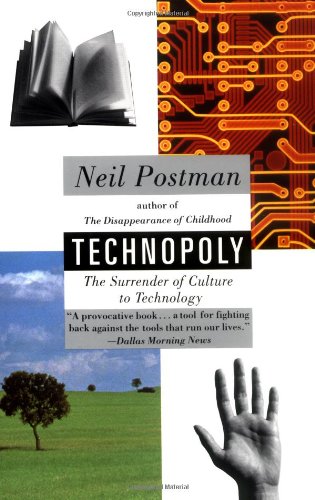
In his book Technopoly, Neil Postman recounts a pertinent story from Plato's Phaedrus in which Socrates discusses the invention of writing via a story of Theuth, an Egyptian god and King Thamus. Theuth brought his inventions before King Thamus for his evaluation before handing them on to his people. Theuth is particularly enthusiastic about writing, claiming it would make the Egyptians wiser and improve their memory. Thamus, the ‘philosopher king’ is less enthusiastic; and he warns that the inventor of something is unlikely to be the best evaluator of his creation. Thamus replies to the god Theuth thus:
O most ingenious Theuth, the parent or inventor of an art is not always the best judge of the utility or inutility of his own inventions to the users of them. And in this instance, you who are the father of letters, from a paternal love of your own children have been led to attribute to them a quality which they cannot have; for this discovery of yours will create forgetfulness in the learners' souls, because they will not use their memories; they will trust to the external written characters and not remember of themselves. The specific which you have discovered is an aid not to memory, but to reminiscence, and you give your disciples not truth, but only the semblance of truth; they will be hearers of many things and will have learned nothing; they will appear to be omniscient and will generally know nothing; they will be tiresome company, having the show of wisdom without the reality.

Socrates is particularly concerned to highlight the importance of conversation, of dialogue, and the art of the question, of adaptation and response in ‘real time’.

One of the seminal thinkers of the modern world, Sigmund Freud, observed the effects of technology in Civilization and Its Discontents:

One would like to ask: is there, then, no positive gain in pleasure, no unequivocal increase in my feeling of happiness, if I can, as often as I please, hear the voice of a child of mine who is living hundreds of miles away or if I can learn in the shortest possible time after a friend has reached his destination that he has come through the long and difficult voyage unharmed? Does it mean nothing that medicine has succeeded in enormously reducing infant mortality and the danger of infection for women in childbirth, and, indeed, in considerably lengthening the average life of civilized man? ... If there had been no railway to conquer distances, my child would never have left his native town and I should need no telephone to hear his voice; if traveling across the ocean by ship had not been introduced, my friend would not have embarked on his sea-voyage and I should not need a cable to relieve my anxiety about him. What is the use of reducing infantile mortality when it is precisely that reduction which imposes the greatest restraint on us in the begetting of children, so that, taken all round, we nevertheless rear no more children than in the days before the reign of hygiene, while at the same time we have created difficult conditions for our sexual life in marriage… And, finally, what good to us is a long life if it is difficult and barren of joys, and if it is so full of misery that we can only welcome death as a deliverer?

You may not like all his examples, but Freud surely had a point. A technology does not simply create possibilities but creates and pushes actualities upon a society. It catches us up in a certain logic, a certain way of seeing things and other people. It recreates our habits. It reshapes our notions of time, space and of place. It changes the nature of our relationships. In fact, it is quite inadequate to talk about technology as having ‘effects’. Rather, technologies involve us. As philosopher Langdon Winner puts it, technologies are “forms of life”.

Watching My Television
The introduction of a new technology does not merely fill empty space. As Borgmann says, life is “already always full” and the introduction of a new device requires a reweaving of the fabric of life around it. Let’s return to our well-known and perhaps well-worn television example. Is a television simply another piece of equipment that exists alongside a piano or a bookshelf? After a day at work, is watching a couple of hours of lightweight television merely ‘just another option’ alongside reading a demanding book or generating a conversation… or prayer? It is possible that devoted readers or classical music lovers may be exceptions, but in most cases the answer is simple and it is ‘No’: television has a prominent place. Chances are it is reflected in the arrangement of your home’s living area and the question, “Shall I watch television?” (if it is at all a conscious question) is hard to avoid. What’s more, should you decide to limit your television viewing, there’s a good chance you’ll be on the outer as you listen to people at work discuss their latest viewing habits: “How is he going to break his brother out of prison?” “Are the ‘survivors’ of Oceanic flight 815 in purgatory?” etc, etc. You may not be privy to what people are talking about when they say, “Not that there’s anything wrong with that…” Missing out on the banter of everyday discourse may be a minor thing (to you) but it illustrates yet another one of the levels on which media and  technology is interweaved with social and cultural reality.

Television as a medium is impatient with words, or, as the visually-biased may say (tellingly), “talking heads”. It favours the visual, the spectacular, and the rapid changing of images and camera angles rather than continuity and development of thought. It is, overall, a feast for the eyes and ears but not a genuine exercise of imagination. The exercise of imagination has largely been done for us by others and the results are on view. Television thus encourages passivity rather than activity and consumption rather than conversation. Its connection to a system of programming is likely to make constraints on our plans, VCRs notwithstanding when the ‘best’ shows are on. It demands our full attention in a room unlike music in the background. Neil Postman asks, “What do Americans do?” To sum up: “Americans… watch… TV.” Australians aren’t all that different. I’m not going to deny my own love affair with television. Along with my favourite dramas and comedies, I watch my fair share of SBS documentaries and current affairs on the ABC. I try to be ‘informed’ though I seem to have more information than I know what to do with. (Am I supposed to act on this stuff? I dunno… Maybe I should ‘blog’ on it… that’ll help…) As Marva Dawn has noted, the constant flow of information widens the gap between ‘knowing about’ and meaningful response.

But returning to the Far Side cartoon, what has been lost? Is there space for conversation in the home that is being needlessly consumed? Can we really join in a pining for ‘community’ if we surrender our time to luxury and private preference? Are we less likely to visit or receive visits? Will we be as likely to learn new skills and crafts? Is our ability to question and think through issues—like technology—enhanced or lessened? We at least need to ask the questions.

Answering My Phones
Being ‘connected’ is part of our contemporary jargon. We need to connect and communicate with each other. It is part of our search for ‘community’. But ‘connection’ in the technological society is partly ideological. To refrain from being connected is to ‘miss out’. Perhaps it is even a sign of irresponsibility in the eyes of some. This is the age of access. Not only do you have access to information, you have access to others; but they must have access to you. Now.

I can hardly remember what it was like not to have a mobile phone. I can certainly remember how helpful it was organising our move from Perth to Melbourne when so many decisions had to be made very quickly and on the move. I value being able to organise something spontaneously. I appreciate knowing that my daughter can ring from her mobile phone if she misses a bus or is lost or needs my urgent help.

But again (and hopefully without sounding like I am moaning) I must wonder about how life is being re-formed around the possession of the mobile phone. With my mobile phone, people know I can be contacted in an emergency. They now also know they can contact me in other cases. And actually, they now expect they can contact me at any time. They are probably annoyed if I don’t respond or, worse, if I do not carry my phone with me at all times and places. It is no longer a mere tool which I can pick up or put down. It is expected that I will have it standing by just as it is expected I will check my email several times per day and respond quickly. It is a cultural commonplace. It is ‘irresponsible’ for me not to have it ready. Sure, you don’t have to use the technology that way; but you’re not using it on your own. You are part of a network. It is embedded in the way we relate now. There are expectations which come out of the values of the technology.

I remember some years ago, (and many students will relate to this experience!), when my home phone was disconnected when I didn’t pay my bill on time. It was a nuisance: though, frankly, not as much of one as I would have expected. A phone call at the local phone booth required some more deliberation: Do I really need to make this call? How urgent is it? Can this question wait until I see that person next? I was also pleasantly surprised by the extra number of visitors we received at home. Was I crazy to get it reconnected?

Being Human in the Human-Built World
The age of access, of information technology, of readily available ‘multimedia’ entertainment (though not nearly as ‘multi’ as it claims) is predicated on the value of immediacy. Our sense of time and space is compressed. E. F. Schumacher spoke of “human scale” and suggested that “small is beautiful.” Reflecting on our relationship to everyday technology will certainly help us re-evaluate our connection to the spaces we inhabit, both the human-built and the natural; and to connect more deeply with the human and non-human creatures which inhabit it. But we may only be able to do that if we can recover a human pace. Carl Honore’s book In Praise of Slow celebrates a reassessment of the way we inhabit our day. Alongside of Schumacher’s suggestion, we may want to add the idea that “slow is beautiful.” What would it mean to recapture a more human rhythm to life? Surely that’s a genuinely Christian concern.

As Christians in a technological society dedicated to immediacy, access and connection, how do we respond? Is there a conformity to the world to be avoided? If so, how should we be “transformed by the renewing of our minds”? What virtues are being confronted by the culture of technopoly? The first that spring to my mind are patience and longsuffering. How can I learn patience with people when everything around me says “hurry up”. This fax is processing the pages too slowly, that web page is taking ‘forever’ to download, and this program is running too slowly! Now will you hurry up and answer my email? Can I learn to anticipate something good and accept the waiting without being frustrated by an inability to turn it on now? Can I be satisfied by what I have rather than be in a rush to ‘upgrade’? Is a ‘better’ technology actually solving real problems I have? Or is it providing an answer to that for which I don’t have a question? Can my children continue to hand in work that is handwritten and not face prejudice? Is ‘Google-ing’ the same as researching?

A recovery of human scale and human pace may require a reassertion of the primacy of our being made in the image of God rather than the image of our own creations. I am more than a fleshy second-rate computer. I am a body with a wondrous array of actions and senses and not just a mind, eyes and ears mounted on a deskchair or lounge chair. The people that God has placed around about me in real space and real time deserve my attention and conversation moreso than the monologue of television.

Recovering a biblical sense of time on the macroscale through the church year may be important as would the smaller scale of ‘sabbath-ing’ regularly. Take off your wristwatch (and make someone in your family or Christian community the designated timekeeper if need be). Any of these scales helps us for some time at least to lift our eyes beyond the immediate (and not just to the business planner either).

Living in the technological society as a faithful Christian may not mean getting unplugged, but it does mean we ought to see our ‘material culture’ as a place of necessary moral and theological reflection and deliberation. But it is not only the devices which inhabit our homes, but the very design of our homes—and our suburbs and cities—which need attention and, at times, resistance and transformation. Perhaps that is a subject to which we should turn in the near future?

Is your living room a place of conversation and shared activity or a 6-7 day per week mini-theatre? Perhaps that’s something worth thinking about for a bit. Just make sure you have your mobile turned off…

“'All things are lawful for me,' but not all things are beneficial. 'All things are lawful for me,' but I will not be dominated by anything.” (1 Cor 6:12)

First published in Zadok Perspectives No. 94 (Autumn 2007), pp. 7-9.

Saturday, February 25, 2012

Can We Be Good without God?

“Can we be good without God?” This is a question that exercises the minds of ‘apologists’ of all sorts, both theists and atheists. In my experience, it is always bound to draw the ire of the on-line blogging and commenting cohorts of the so-called ‘new atheists’. Sadly, it is a topic fraught with tension that lends itself to combative to-and-fro. Making and taking critique of morality can very quickly become very personal. If substantive morality without God is called into question, some atheists can’t help but imagine that their own moral life is being rubbished.

The proper distinction failing to be made in such matters is between the actual moral performance of people on the one hand and a reasonable justification for ethics on the other. There is no doubt that there are people who identify themselves as atheists who live morally exemplary lives, just as there are staunch believers in God whose behaviour is morally questionable… or worse. Still, unpopular though it may be, it is a live philosophical question (with much practical and political import!) whether the higher moral ideals of the so-called Western world—and the atheism with which we deal is pretty much a peculiarly Western and post-Christian phenomenon—are adequately justifiable in purely non-theistic or non-religious terms. Whether or not particular people are morally laudable is not the final answer to the question of the justification of morality. We can reasonably ask, What are the sources of our particular moral outlooks? What kind of moral behaviour can we reasonably expect from our fellow human beings in a culture that seems to have bought into the ‘death of God’? What vision of goodness can be sustained in a post-Christian society?

In such a society, the two main sources for ethics are either nature (a contested term if ever there was one) or society. ‘Nature’ is certainly not straightforward. We might be appealing to something called reason or to other ‘natural’ human capacities. If ‘reason’, then which ethical theory wins the day? Kantian duty-based ethics or perhaps utilitarianism? The philosophers continue to debate theories just as long and hard as any contentious religious argument over the proper interpretation of Scripture. Furthermore, the reduction of ethics to rationalistic maxims fails ot grapple adequately with the complexity of ‘the moral landscape’. Rabbi Jonathan Sacks comments:

“How bright were the hopes of the rationalists in the 18th and 19th centuries that the good life could be reduced to a simple formula. Treat persons as ends, not means, said Kant. Act so as to produce the greatest happiness for the greatest number, said Bentham. Forbid only the things that harm others, argued John Stuart Mill. These beautiful oversimplifications remind me of the snatch of dialogue from Woody Allen. “I’ve learned to speed-read. I read the whole of War and Peace in one hour.” “What’s it about?” “Russia!”

What aspect of human nature can be our guide? Is ethics some kind of realisation of human potential; a kind of commitment to excellence or particular virtues? But if so, which qualities are to be preferred above or instead of others? We have many different drives and desires, aspirations and appetites, cravings and compulsions. Outside of our permissive society, the wisdom of most philosophies and religions has urged discernment and discipline in resisting, delaying or even denying certain urges. Human nature, as we actually experience it, does not merely generate altruistic feelings. Honest self-knowledge recognises darker tendencies within.

In that case, the affirmations of some that ethics is largely explained by some benign biological impulses that give us an evolutionary advantage seems vague, inadequate, and even a little out of touch with history. But such affirmations are designed not so much to give genuine explanations as to merely to serve anti-religious polemics. They tend to give us stark (but false) alternatives: either we recognise the intrinsic biological roots of ethics or we rely upon the extrinsic pronouncements of God or the gods to tell us what to think and do: biological science versus a divine command caricature. ‘Religious ethics’ becomes, in this simplistic picture, an exercise in consulting some exhaustive index of arbitrary divine directives (or odd human rules masquerading as divine commands).

However, Christian ethics does not require a denial of the biological grounding of many of our moral impulses—Why would there be a problem with recognising that we feel deeply stirred in our bodies with compassion, empathy or love? Christian ethics does not deny that following the will of God—or pursuing any human cooperation for that matter—is in a deep sense congruent with who we are as physical beings. It does question—along with most other philosophies and religions—naïve accounts of human nature as simply an unfolding of the good, or the idea that simply reflecting on our desires will reveal to us which way to live.

Grappling with the complexities of human nature is a task we undertake with others. Human existence is social existence and so our co-existence with others requires much give-and-take in life; a recognition that we must curb ourselves at times—perhaps much of the time—to make space for others. We are shaped and in a sense ruled by social custom and conventions. Some new atheist apologists seem to think that pointing to this basic social need for reciprocity provides an adequate answer to the big philosophical question of morality. We need to live together as a matter of proper functioning, so what need to speak further of divine or religious contributions to morality? But what does reciprocity significantly tell us beyond the need for social cooperation? Does an appeal to reciprocity actually tell us what we ought to do? Does it provide serious guidance to the questions of bioethics, new technologies, questions of war and international competition?

We cannot appeal to the mere fact of sociality to provide a substantive account of moral life; but neither can we simply appeal to the particularities of our community and culture as a sufficient ground for ethics. To make our particular social arrangements and inherited judgements, embodied in tradition, the final standard for moral norms is to surrender the aspirations of morality to an acceptance of the status quo or acquiescence to moral relativism. Is slavery ‘moral’ in a certain place simply because it is widely practiced there? While the particular history of judgement, deliberation, and discernment of our community is important, it cannot be the final justification for action—there needs to be a higher court of appeal, higher aspirations or purposes to call us forward, and a higher authority to hold us to account. As important as community and tradition is, if it becomes the basis for ethics, we risk trading ethics for mere politics, and therefore morality for the exercise of power.

In his Ethics: SystematicTheology, James McClendon describes a fully-fledged Christian ethic as incorporating three strands: the body strand, the social strand, and the resurrection strand. Just as a rope is made up of several strands and no strand alone can do the work of a rope, so Christian ethics requires all three strands to function properly. Rather than being denied, the biological or organic aspect of humanity is affirmed but deemed insufficient as a final guide. Our desires are shaped in recognition of shared wisdom, social arrangements, and deliberations along the way of a shared journey in life together are all affirmed as legitimate and indeed necessary aspects of ethical life. But again, they are not the final word.

The story of each and all is itself hungry for a greater story that overcomes our persistent self-deceit, redeems our common life, and provides a way for us to be a people among all earth’s peoples without subtracting from the significance of others’ peoplehood, their own stories, their lives… Christian morality involves us, necessarily involves us, in the story of God.

God acts and speaks, creates and redeems, calls and commands in order to shape new life along the way of history. This resurrection strand of ethics is God’s revelatory and redemptive activity to do “a new thing” among us, to create new possibilities in response to the gospel of God’s saving action in Jesus Christ. Ethics is the shape of shared human life under the vocation of God in Christ. It also includes an openness to creativity and imagination in practical judgements about ethical cases.

If there is security and confidence to be had in recognising this third strand of ethics, there is also a need for us not to be triumphalistic apologists regarding Christian ethics. We must acknowledge the failure of Christians past and present to live in accordance with their own pronouncements. (The message of forgiveness is a great comfort but ought not be used as a pious veil over wilful wrongdoing.) But perhaps more importantly in questions of justification of morality, we cannot trumpet the good news of a deep divine source for ethics without also recognising the problems of living Christian morality. Grounding ethics in the character and purposes of God does not automatically lead to clear and discrete answers to complex moral problems. We still have many disagreements about the shape of our lives. Hermeneutical disagreements arise not only from poor use of Scripture, but also from the legitimate pluralism of moral judgements that arises from many people seeking faithful ways forward. Christian ethics draws upon a wide variety of resources: a compilation of wisdom, prophecy, testimony, parables and stories of divine and human interaction that provide an imaginative world in which to confront both persistent and new challenges in our lives together: but that rich variegated resource also lends itself to many possibilities.

Moral life is complex; moral problems are complex; and the resources we need to deal with them are also complex. We must resist the oversimplification of the apologists of atheism and Christianity to score easy wins in the argument over God and morality. Christians must remember that it is in the patient and gracious exemplification of moral reflection that Christian ethics gains a hearing in the wider world rather than an abstract appeal to a divine authority.

Can we be good without God? We are all troubled by others’ and our own behaviour, relieved at other times, and on occasion delighted. But we expect or at least hope for more from others and ourselves. Do we have good reason to do so reflecting upon the ambiguities of human nature within an ultimately impersonal universe or are we merely provided with excuses? Do we have good reason to expect more from our fellows if our society drifts in less charitable directions, with no higher authority than itself? There is ultimately only good reason to hope for more if there is Good News: a Higher Authority who not only exemplifies goodness, but surprises us with his call, care and companionship, to save us from ourselves and increasingly close the moral gap between who we have become and the ‘much more’ that we were intended to be. That indeed flows from the good news of Jesus Christ and in the end can only be the work of God.

Wednesday, September 14, 2011

Mulling over Vocation - Prologue to a Theology of Calling

What might it mean to live an authentically human life? What might we mean by ‘authentic’ when asking such a question?[1] And what might it mean to ask such a question in the first place? Is there something which compels me or perhaps compels us to look beyond what appears as merely given by nature or society? Is there something within human beings why cries out to be realised, a potential groaning within, longing for expression or growth and development? Or is there a larger natural order that exerts a pressure upon us to either conform to a role within a complex ecology, either providing a space within which our capacities are to expand, or pushing down upon us to constrain some promethean disposition[2] and help us to learn to live within limits? If so, could we speak of a responsibility to such an order or is this a metaphor that indulges an unjustifiable anthropomorphism? Or is there something that or someone who transcends the finite order? What might it mean to respond to a ‘transcendent order’? This still seems too abstract and impersonal and simply a matter of choice as to one should follow it up. Can one speak of a human purpose? Can there be a compelling reason beyond mere utility if we bracket out the question of divine authority?

What is the extent of the demand—if we can call it that—that comes from nature? We can concede, at any given time, that there are structures and processes that appear unshakeable and unmoveable—we call them ‘laws’ (and we are barely conscious of the metaphor that presumes a divinely instituted order)—and we are then left to judge whether or not we must therefore accept our fate within an untameable world or whether we can exploit these same laws to change our vulnerability in relation to the supposed giveness of our condition.

What we call ‘ethics’ exists within this question of living within an alternately ambiguous and inflexible ‘nature’ as the lower level of normativity, within alternately agreed and contested judgements in society about human flourishing, as a slightly higher level; but then with an orientation to vocation—a larger vision of life to which we are compelled or summoned—that may suspend particular natural potentialities or social obligations; that is, there may be the need to endure suffering, to abstain from certain worthy goods such as ample food, shelter or perhaps sexual relations, or to leave behind social roles or relationships that might have seemed unproblematic.

The question of vocation—whether or not there is a call that reaches into the life of a human being (or a community) and reorients its shape and purpose—is not simply a luxury of the wealthy professional or even the relatively wealthy person of the so-called ‘developed world’ seeking out or simply honing their craft or trade. It is a question that can stir in the heart and mind of any person who, perhaps only for a moment, can lift her eyes from what is immediately in front of them—the plough, the chisel, the brush, the pen, the keyboard—and can envision a different world and her place within it. Perhaps it is no settled place but only a path marked out toward it, in hope that others will reap the benefit of her labours.

What might that different world look like? Perhaps it is simply a better version of what is right here, this time and place. Or is it the world turned upside down? If there is a call to a different world, does it send one back to the plough, the chisel, the brush, the pen, the keyboard, perhaps with a renewed vigor or resolve, to do what one was already doing, to cleave with fidelity to the history that brought this person to this place and this task; to love the community which in part sustains her and in part relies upon her? Or does this call to a different world turn her world upside down also. Must she ‘lay aside her nets’ and take on something so strange and unexpected as, say, a ‘fisher of men’, something with connection to previous life as tenuous as a metaphor.

This question of a different world and the possibility of vocation invites deeper questions about the nature of mundane and transcendent realities. Can we conceive of our quest as simply an unfolding of nature’s potentialities, simply riding the wave of some progressive dynamic inherent in the cosmos that carries humanity (as far as we know) at its leading edge? In such a world, we are not so much ‘called’ to a way of living as living according to the nature of things. The problem of evil and the naturalistic fallacy shadow us. But why this way of life and not another? In a universe that feels like it is not wholly determined and seems open to a variety of possibilities, what is it that could urge a particular shape to human life that is more than provincial and customary?

This is the question of vocation.


[1] So Greg Levoy, Callings: Finding and Following an Authentic Life (New York: Three Rivers Press, 1997); cf. Charles Taylor, The Ethics of Authenticity


[2] Cf. Gerald McKenny’s characterisation of the Baconian project in To Relieve the Human Condition: Bioethics, Technology, and the Body (Albany, NY: State University of New York Press, 1997)

Tuesday, April 19, 2011

Are We Having Fun Yet? Rest, Joy and Play in a World of Trouble

Christians generally don’t take much convincing that life is serious business. But what about the idea that life could be—or even should be—fun? Is that even a legitimate theological question? And who gets to ask questions like that in this troubled world? In the wake of floods, fires, earthquakes and tsunamis, it might seem frivolous, insensitive or even sinful to inquire about such things. Certainly, there is a question of timing—“rejoice with those who rejoice, weep with those who weep”. But perhaps this is in fact an ideal time to consider the place of fun. If, after all, Australian Christians live in an affluent culture that more or less takes it for granted that space for fun should be a given (some may even say ‘a right’!), looking at a theology of the enjoyment of life ought to have one eye on the realities of suffering and struggle.

We can expect too much from life in the present. But it is also possible to hope for too little. Any Christian assessment of life exists in the messy middle between two horizons: behind us, God’s good creation and benevolent intentions, including human flourishing; and, before us, God’s intentions realised in the renewal of creation, or ‘a new heavens and a new earth’. It is possible to get so caught up in the messiness of the middle—where work can become toil, where delight meets disappointment, where friendships can be fractured—and lose sight of those framing horizons that remind us that the world is not out of control but our patient, faithful God remains in charge and will accomplish all He has set out to do.

In the opening story of Genesis, we are invited to see humanity enter the scene on God’s day of rest. Rest is a necessary precursor to work, just as it is a proper end or goal. Living without an appropriate sense of Sabbath rest distorts human life. How many people feel crushed under the weight of workloads that seem to pile up without end, weight that stays with them even when not in the office or on the job site? And what of ministry-without-end? A failure to rest ultimately takes its toll on our productivity but there are more than utilitarian reasons to rest. Marva Dawn speaks of Sabbath practice entailing ceasing, resting, feasting and embracing. ‘Ceasing’ opens for us a fresh space to see a world outside, beneath, above and beyond the logics of economy, productivity and growth. ‘Resting’ renews us. (For women as well as men—let the reader understand.) ‘Feasting’ shows us there is time to celebrate and be thankful. Unthankfulness is a fundamental sin in the progression of the world’s distortion and depravity in Romans 1, leading to a ‘futile mind’. ‘Embracing’ reconnects us with our primary community and family, ties of baptismal water and ties of blood rather than commercial exchanges. It is the time and place of generosity and hospitality.

We need to be released from a false sense of guilt for not being productive, even “for the kingdom”. Even theologies of ‘vocation’ can become complicit in a drive to work, to perform, to achieve. But the One who sought labourers for an imminent harvest in Israel also called those who were “weary and heavy laden” to find “rest”. The Suffering Servant was paradoxically known as one who frequented celebratory feasts as signs of the inbreaking reign of God.

Space to rest is one component of a life that flourishes as God intended. Delight is another. It is ironic that a culture like ours devoted to entertainment finds itself continually bored, avoiding feelings of futility, and looking for the next big thing. The entertainment culture is itself driven and without rest. There is an excess of stimulation and titillation around us—but little delight in the excess of God. Real enjoyment is thus threatened and fun becomes fleeting and unsatisfying. Delight cannot be contrived. If there is such a thing as ‘faithful fun’, then space to cease, rest, feast and embrace and so to cultivate moments of delight in God and God’s world must be a part of that. We must intentionally and regularly seek out this space. And having found it, let intentions fall to the side and let the freedom, spontaneity and surprise of play to take over.

False guilt for enjoying life does nothing to help those in less happy circumstances. It can even reflect a profound lack of thankfulness for being the particular creature you are in a particular time and place. Be thankful for the blessings that you have. And in the space of ceasing, resting, feasting and embracing, delight in the Lord, play before him, and be re-energised for your small part in the ongoing work of justice in the world. Enjoy that which God has allowed you to enjoy with some ‘faithful fun’.

And then think how you might generously share the joy of rest with those who go without.

Tuesday, February 22, 2011

Reframing Rights Language

The language of rights has become the predominant lingua franca of moral discourse in Western democratic regimes. Rights language is powerful language; indeed it is something of a ‘fighting creed’. At its best, it calls for a recognition that access to vital goods is being denied or hindered by agents or agencies that have no moral or political legitimacy to do so. There is strength in rights language. Perhaps for this reason in particular, it has become customary and even instinctive for persons to state their moral viewpoints or make their claims in terms of rights. This is most unfortunate for a variety of reasons.

Rights language tends toward the absolute and uncompromising despite the recognition by policymakers, lawmakers, and those who implement policy that rights claims must be prioritised and balanced with competing claims. Framing moral claims or aspirations in terms of rights does not automatically guarantee their legitimacy nor the capacity for other persons or institutions to meet a need. Such claims are frequently stated in conflictual or adversarial manners, sometimes justified, sometimes not. It is not surprising, therefore, that there is some resistance to an inflation in rights discourse for fear of the adversarial stances and seemingly irreconcilable positions we see in debates—such as those surrounding abortion—being extended to more areas. (Similarly, the adversarial and litigious culture of the United States is not one we desire to see transplanted in any way in Australia.)

The capacity for our society to have coherent moral discussion is in a bad state. Numerous philosophers, social theorists and theologians have provided various diagnoses of this reality in our pluralistic culture which pressures us to create an ostensibly neutral, supposedly ‘secular’ language. Human rights discourse appears to some to be just that. However, it is more likely that our instinctive leap to claim ‘rights’ for all and every moral or political aspiration is not access to a universal moral language so much as an attempted shortcut to getting what we need (or perhaps just want) rather than going through the difficult processes of moral argument and persuasion.

In looking for a reframing of ‘rights’ language, it is not my intention by any means to resist moves to see the poor and marginalised, the victimised or oppressed lose what rights they have or fail to be protected with rights they should have. I desire instead to see processes of deliberation and education that properly grounds rights and really do advance our aspirations to embody the ideals of the Universal Declaration of Human rights in its complex outworkings.

The social dimension of rights needs to be properly elaborated in any discussion. It has been rightly said that discussion of moral and civic responsibilities needs to be increased; though it is difficult to see how well this discussion can be encouraged in an individualistic culture where the assertion of a ‘right’ to ‘do what I like’ so long as ‘I don’t hurt anyone’ is paramount and what ‘hurt’ actually entails is unclear or hotly contested.

What exactly are rights? I suggest that rights are warranted claims on a commitment of a particular society or agency thereof to guarantee particular goods or prevent unfair restrictions to access them. We do not simply ‘have rights’ as ‘individuals’. We have rights in community with others committed to our mutual good. We can legitimately argue that there are rights that all human beings ought to have. In this respect we can call them ‘human rights’. In other words, rights do not trump moral argument or recognition but are their outcome. We recognise there are certain essential goods (such as particular kinds of freedom) that are essential for human flourishing. When we commit to guarantee access to such goods insofar as it is reasonably possible for us, these can be enshrined as rights. However, the process of social recognition should not be subverted by the mere claim of a (novel) right and enshrinement through legislative stealth. The place of cultural deliberation and social recognition must be upheld. If cultural deliberation is subverted through overreliance upon rights language, we actually undermine the discussions of common good required to create or sustain a culture that is truly committed to ‘human rights’.
Such concerns need to be at the centre of any ongoing discussion of the future of rights in our country. Any rush into expanding rights discourse that does not adequately deal with these difficult and problematic issues is ill-advised and may well lead ironically down a path of less concern for each other in our diversity and for those in serious need. Our responsibilities to help others must transcend ‘rights’ and reach for a higher justice. 

Thursday, February 03, 2011

Remembering Our Primary Social Calling

In some form or another, most Australian Christians realise that their ethical and political convictions should bear the marks of the gospel of Jesus Christ. The rediscovery by many Christians that the gospel is indeed ‘public truth’ has led some to assume that the primary means of Christian social influence is to grasp at the ‘levers of power’ in order to press home any residual Christendom advantage we might have before we are lost in some feared flood of secular and/or multi-religious voices.

Yet fears—real or imagined—while being impressive short-term motivators (as politicians show us especially at election time) are unworthy of those who dare to make the claim that the crucified Jesus is the risen, ascended Lord. While Christians should not sit idly in the midst of problematic social change and ethical challenges, there is something disturbing about the moral panic that is trumpeted by some Christians as though the redemption of the world was all up to them. There is something faithless and impatient about all of this.

Christians are indeed sent into the world to make a difference but the means by which that difference is sought are just as important as the ends. The attempt to guarantee security for the church’s voice through the machinations of legal and political apparatus may well be overlooking the depth of challenge that the death and resurrection of Jesus makes to our settled view of things. Our baptism into this death and resurrection does not remove us from the world but neither does it send us back with a sense of superiority and urge to rule and direct the lives of others in the name of the ‘word of God’. Those who would be ‘reigning with Christ’ are sent back into a world with a whole new ethos exemplifying what it means to live in the world that God in Christ really has reconciled to himself. That is a task to be lived out at cost to ourselves at every level of life.

Dietrich Bonhoeffer (Letters and Papers in Prison, pp. 382-3) reminds us that

the church must share in the secular problems of ordinary human life, not dominating, but helping and serving. It must tell [men and women] of every calling what it means to live in Christ, to exist for others… It must not underestimate the importance of human example… it is not abstract argument, but example, that gives its word emphasis and power. 
Such a life must be lived in the manner of the One we follow: not trusting finally in the securities of state, law, or social kudos, but in the God who raises from the dead and whose kingdom will indeed come on earth as it is in heaven.

Wednesday, February 02, 2011

A Call to Civility

When the Americans emerged from a mid-term election, it was with few surprises, not only in terms of result but regarding campaign style and character. It seems Americans have reached a point in political life where they have become used to a quality of political discourse that has degenerated to new levels of shallowness and disrespect. The freak show of American cable ‘news’ and punditry, the ugliness of shrill, combative blogging and the substitution of personalities and polling for policy debate all sound alarm bells for the health of civil society and a functioning democracy. Undoubtedly, the U.S.A. is a different country to Australia with its own narrative and mythology concerning its imagined origins and destiny.

Yet many of the same worrying signs have appeared in Australia—and among Australian Christians. The ‘culture wars’ mentality of so-called Left and Right wings of politics increasingly hardens believers into inflexible progressive versus conservative camps who can only value a victory for their ‘godly’ agenda over that of their enemy. Their enemy. Not simply a political opponent. Not even a partisan adversary. Enemy.


The depth of this antipathy can be debated. But at least on the surface, at least at the level of public rhetoric, political discourse has taken a turn for the worse. Too many Christians and Christian organisations have tied themselves to predictable political party lines and anointed themselves as priests and prophets of God’s political will, ready to decry Christians who disagree as they would the prophets of Baal. The willingness of believers to sling mud at fellow believers disturbingly mirrors the media sound bites of political antagonism. Politics has been captured by cynical exercises in character assassination… but where is the counter-witness of the gospel among Christians?

This political situation exudes disrespect on three levels. First, it shows disrespect to the systems, principles and practices of governance that frame our attempts at democratic discourse. Rather than champion analysis and discussion of vision, ethos and policy, the politics of disrespect utilises ‘new media’ to drive singular pre-packaged messages through, frequently promoting suspicion and fear. This undermines the public square as a forum of debate and deliberation concerning the common good. Second, this politics is disrespectful of our leaders, our representatives in government. If Australians have been characterised as holding authority figures in relatively low esteem in the past, they now risk downgrading this to new depths of mockery and loathing. Whatever disappointments or failures we find in particular politicians, this is no excuse to undermine leadership or to discourage the more noble motivations for entering politics through excessive personal scrutiny, lampooning or character assassination. Third, this politics is disrespectful of those represented, the citizens of Australia. It reduces the body politic of citizens to a mob thought to be below serious thinking or incapable of mature cooperation in search of the common good. Is this a situation Christians want to see deteriorate further or can we move toward being part of the solution?

This requires a change in culture. But at the least it ought to begin among Christians. Jim Wallis of Sojourners in the United States has promoted a ‘civility covenant’ for American Christians to embrace, to move against the flow of their political culture. It is reproduced here below. We invite you, your church or Christian organisation to embrace it.
__________________________________________________

Too often, however, we have reflected the political divisions of our culture rather than the unity we have in the body of Christ. We come together to urge those who claim the name of Christ to "put away from you all bitterness and wrath and anger and wrangling and slander, together with all malice, and be kind to one another, tenderhearted, forgiving one another, as God in Christ has forgiven you" (Ephesians 4:31-32).

1) We commit that our dialogue with each other will reflect the spirit of the Scriptures, where our posture toward each other is to be "quick to listen, slow to speak and slow to become angry" (James 1:19).

2) We believe that each of us, and our fellow human beings, are created in the image of God. The respect we owe to God should be reflected in the honour and respect we show to each other in our common humanity, particularly in how we speak to each other. "With the tongue we bless the Lord and Father, and with it we curse those who are made in the likeness of God....this ought not to be so" (James 3:9,10).

3) We pledge that when we disagree, we will do so respectfully, without falsely impugning the other's motives, attacking the other's character, or questioning the other's faith, and recognizing in humility that in our limited, human opinions, "we see but a poor reflection as in a mirror" (1 Corinthians 13:12). We will therefore "be completely humble and gentle; be patient, bearing with one another in love" (Ephesians 4:2).

4) We will ever be mindful of the language we use in expressing our disagreements, being neither arrogant nor boastful in our beliefs: "Before destruction one's heart is haughty, but humility goes before honour" (Proverbs 18:12).

5) We recognize that we cannot function together as citizens of the same community, whether local or national, unless we are mindful of how we treat each other in pursuit of the common good in the common life we share together. Each of us must therefore "put off falsehood and speak truthfully to his neighbour, for we are all members of one body" (Ephesians 4:25).

6) We commit to pray for our political leaders - those with whom we may agree, as well as those with whom we may disagree. "I urge that supplications, prayers, intercessions, and thanksgivings be made - for kings and all who are in high positions" (1 Timothy 2:1-2).

7) We believe that it is more difficult to hate others, even our adversaries and our enemies, when we are praying for them. We commit to pray for each other, those with whom we agree and those with whom we may disagree, so that together we may strive to be faithful witnesses to our Lord, who prayed "that they may be one" (John 17:22).

We pledge to God and to each other that we will lead by example in a country where civil discourse seems to have broken down. We will work to model a better way in how we treat each other in our many faith communities, even across religious and political lines. We will strive to create in our congregations safe and sacred spaces for common prayer and community discussion as we come together to seek God's will for our nation and our world.

Monday, August 23, 2010

Some thoughts on engaging politics as a Christian

Here’s a little outline of how I approach politics, how I decide which political party to vote for, and, more broadly, how I think about political matters as a Christian. I write this brief post - 1. Self-conscious that some of my friends are more politically and theologically literate than me. 2. Acutely aware that there is only so much you can say in a blog post. 3. Not claiming any originality in these thoughts (my thoughts on politics have been influenced significantly by John Rees, Jim Wallis, Walter Wink, Ronald Sider, Ernest Bammel, Stephen Mott, to name a few. See especially John Rees's article for Zadok Perspectives, “Approaching Politics”, No.72 Spring 2001. You'll note, if you read that article, how influential John Rees has been on my thinking in this area. All kudos to John - he was a mentor of mine while at theological college). 4. I am not going to suggest who you should vote for – just offer some thoughts shaping how I approach politics.

So here I go:

1. ‘Politics’ is a broader phenomenon than ‘party politics’, and whenever human beings live together in social groupings they are effectively involved and embedded in ‘politics.’ Human organisation, personal decision-making, allocation of power and authority, gender issues, articulation of values, formation and reinvention of cultural and social traditions – we are all swept up in ‘politics’ before we even begin to reflect critically on ‘party politics’

2. Biblical authority and interpretation, and theological hermeneutics, are crucial starting points for a Christian approach to politics. Yet we often manipulate and distort Scripture for our own ends, or, conversely, ignore Scripture altogether and make political decisions unreflectively or based on other concerns or convictions.

3. Scripture and biblical ethics can provide us with a rich source of information and conviction in our political decision making, but there are many particular contemporary issues where Scripture is silent. So we need to build a foundation on Scripture, when we engage in political discussion or decide who to vote for, while recognizing that we will have to move from this foundation into conversation with others (other Christians, other Christian traditions, and those who are not Christian) about particular political issues, as we seek to make an informed, mature, biblically-faithful, and Christ-honouring decision.

4. While we live in a world that is estranged from God and distanced from God’s original intent (there are many ways to talk about this theologically, so, please, feel free to fill in the blanks), my conviction is that our call to discipleship includes a political dimension, and the need to uphold, engage and even confront the political processes of the day, and of the society of which we are a part. We can’t avoid this. Peacemaking, confronting the principalities and powers, loving enemies, proclaiming the Gospel, heralding the Kingdom, advocating for indigenous rights, caring for the orphan and the widow, devolving power, advocating for the poor and powerless, building genuine community – these are profoundly political actions which, when done in the Spirit and for the sake of Christ, cannot go unnoticed politically. For me, these ‘political’ actions are augmented through voting and through cultivating an active voice in the theatre of ‘party politics’ (individually and as Christian corporately). My voting needs to demonstrate a real concern for the issues I have raised above (peacemaking, justice, compassion, truth, generosity, etc), but, more importantly, the whole of my life should be oriented toward reflecting the mind and passion of Christ in these matters.

5. Government authority is legitimate, but it is ‘under God’ and is never autonomous, since it is subject to the supreme authority of God. Hence, while it must be honoured, and even obeyed when it does not transgress biblical ethics or injunctions, it is to be confronted by Christians through their proclamation of - the Gospel, the characteristics of the Kingdom, the justice articulated in the prophets and the Law, the original creation intent, the eschatological vision of Scripture, and so forth.

I'd be interested in how you would develop, contradict or respond to these thoughts

Graham Hill

Saturday, August 14, 2010

Conversion of the Imagination

“Where there is no vision the people perish.” So begins the King James Version of Proverbs 29:18, half of a verse doomed, it seems, to be regularly ripped from its context and made to serve the latest ‘leadership techniques’ proponent—coming soon to a clergy seminar near you. It’s not that there isn’t a morsel of wisdom here, in recognising that people need common purpose to survive together; it’s that the proverb itself points to the need for an unveiling—a revelation—of God’s purposes for God’s people to flourish in a contrary world. There’s nothing esoteric or especially mystical about grasping revelation, but it’s no simple matter either.

But we like things to be simple. When things are simple we feel we can master them, and we can use them for our purposes. But revelation breaks into our world with the new, the unexpected and, despite our attempts of mastery, the untameable. We are often reductive in our use (note even the word ‘use’) of the Bible. But Scripture is diverse and complex—commands, stories, wisdom, visions, proclamation—and it is not meant to be mastered so much as we are meant to be mastered by the story it tells.

The great 20th century Swiss theologian Karl Barth spoke of the “strange new world” into which the Bible draws us. It is not simply the cultural, temporal and often geographical distance of the people who populate its pages that make it strange, but the unsettling and disturbing activity of God who summons us to new life through his ‘living and active word’. Living in that new life, in that strange new world, requires a conversion of the imagination. Not simply a change of beliefs, or assent to doctrines, or even just a new ‘worldview’ but a renewed imagination. This is not the ‘imagination’ of John Lennon—the wistful dream of utopian humanist possibility—but the deep, ongoing realignment of our hearts and minds, our affections and convictions, to the new reality of God’s coming kingdom, a new world already, subversively ‘on the way’ because of the life, death and resurrection of Jesus and the sending of the Spirit.

But our everyday world is a taken-for-granted world. Even when Christians identify particular problems and decide they want to make a difference, it is often within the constraints of the wider ‘imagined community’, of the assumed way things ‘simply are’. As William Cavanaugh says, “We are often fooled by the seeming solidity of the materials of politics, its armies and offices, into forgetting that these materials are marshalled by acts of the imagination.” But these materials and these structures are not neutral, just waiting us to infuse them with new ‘values’. “Far from merely ‘secular’ institutions and processes, these ways of imagining organise bodies around stories of human nature and human destiny which have deep theological analogues.” Philosopher Charles Taylor calls these ‘social imaginaries’: the images and stories that are shared by a large group of people providing a common understanding that makes possible common practices and gives a sense of their legitimacy and perhaps the seeming necessity of this particular order of things.

Our imaginations are a theologically contested battleground. In Colossians Remixed, Brian Walsh and Sylvia Keesmaat remind us that the early Christians lived in a world where images of the emperor—‘son of god’, ‘lord’, ‘saviour’—and imperial power, of the ‘proper’ gods and goddesses, were found in public squares, gymnasiums, baths, on coins, and even on many items for private use. The Roman empire not only colonised new territories but colonised the imagination of people; giving them a new ‘normality’ and socialising them into a new status quo. The more pervasive the images, the more invisible, natural and taken-for-granted the social order and its legitimating ‘theology’. The more natural the imagined community feels, the less obvious it is that is merely contingent and open to change or subversion. Into this world came Paul’s gospel of Jesus—the Messiah of Israel and resurrected and ascended as the world’s true lord. According to his gospel, the Messiah, the Christ, was the true image of God and the true lord in whom everything had its centre and held together. To those who were learning in Christ the new reality, the present order of things was seen not as normal but “passing away”.

The images and regimes of previous times seem obvious and problematic to us. But what are the ‘imagined communities’ and ‘social imaginaries’ of our time? In Desiring the Kingdom, James K. A. Smith suggests that because our “worldview-thinking still tends to focus on ideas and beliefs” we do not fully recognise the “formative cultural impact of sites like the mall” despite our rather obvious denunciations of greed and ‘consumerism’. “Because our hearts are oriented primarily by desire, by what we love, and because those desires are shaped and molded by the habit-forming practices in which we participate, it is the rituals and practices of the mall—the liturgies of mall and market—that shape our imaginations and how we orient ourselves to the world.”

The Christian public response cannot simply be one of scolding wider society while we do not see through and tackle our tacit collusion with the status quo. How can we be enabled to see through the ‘passing’ reality and see God’s new reality afresh? How can our imagination be transformed? No easy answers here.

I was recently at a conference where a church leader and seminary lecturer asked how we could disciple people in this consumer culture. No one could give a substantial answer. It was as though the question had tapped into the uncertainty of the pastors present. But we must recognise this is a necessary long-term project for each congregation and not something rectified by a sermon series or an ad campaign. Our reconstruction, as Walter Brueggemann says, “is a slow, deliberate work done over time, one text at a time.” Hard work no doubt. However that’s not merely about ministers getting their exegesis right and then giving a few principles as ‘application’. We cannot live in the story of God unless we allow that story to live in us, to “let the message of Christ dwell among [us] richly as [we] teach and admonish one another with all wisdom” (Col. 3:16). As we approach the Bible in congregations and small groups, we must be sure we are grasping the scope of the concerns of God’s kingdom and realise, like the early Christians, that Jesus Christ is calling into question the present order of things. And this engagement with Scripture requires us to radically question ourselves, each other and the world around us, even in its seemingly mundane aspects. Our workplace conditions and conflicts, our child-raising, our love of technology, our home design, our time on-line, our reading or lack of it, our conversation, our use of cars and energy resources, our recognition of the creation, our listening to others… there is no part of life that falls outside the concern of Christ. Activate your imagination as you give time to enter the world of Scripture with others and see the world afresh.

‘Wisdom’ is another name for this transformed imagination and wisdom does not come easy. Maybe that’s why we often lack it. Augustine recognised that Scripture is difficult and we should not shy away from that. The point of that difficulty was to keep us engaged with it together, struggling and learning and firing our imagination. As we tell and retell the story of the Bible, centred in Jesus Christ, gathered around his table of gracious hospitality and fellowship, in practices of servanthood and peacemaking, seeing each other as God’s new community, let our imaginations be mastered so we may see through the status quo and embody a genuine alternative for the sake of God’s world.

Thursday, April 08, 2010

Ethics, 'Religion' and 'the Secular"

The question “How shall we live?” is, quite simply, a question that will not go away. Whatever our gains in scientific knowledge as we penetrate deeper into the structures of the natural world; whatever our advances in technical expertise as we attempt feats of impressive engineering and pioneer new modes of medical research; whatever our wealth amassed in business enterprise, we must return again and again to questions as ancient as recorded history: How can we co-exist with neighbours, with nations and with nature? And not merely co-exist but positively flourish together as communities of human beings? These are fundamental questions that have exercised the minds not only of the world’s great thinkers but concerned members of all societies, especially in times of crisis and social change. And, for the most part, these questions have been considered in relation to the ‘big questions’ of metaphysics, religion, and theology.

While these fundamental questions remain, undoubtedly the conditions within which they are asked have varied, as have the details of specific problems and aspirations as they have been shaped by specific cultures, natural environments, technological change and, in the last half-millennium, Western science. It is obvious that people of earlier times did not have to grapple with our complex economies and technologies, nor with the capacity of human beings to devastate the natural world to such a degree: so no suggestion of simple transposition of pre-modern norms is straightforward or sufficient. That is clear enough. What is less obvious to us—and even positively insulting to suggest to an ‘advanced’ post-industrial society—is that, overall, our capacity to negotiate our way through moral complexity is pitiable in contemporary liberal democratic capitalist society. In the face of the challenges that confront us, however, now is not a time for ‘chronological snobbery’ one way or the other but rather a reinvigorated conversation about the retrieval of ancient wisdom and its critical dialogue with particular modern and ‘postmodern’ insights.

However, as soon as we speak of “ancient wisdom”, a collection of issues often bundled up together under the vague label “religion” swings into view, immediately evoking a number of negative responses. In the deluge of media and ‘information’ we have to navigate our way through today, it is often difficult to distinguish between the responses worth a hearing and those, frankly, not. The cacophony of protest to almost anything resembling strong belief (except perhaps in ‘individual autonomy’ or sometimes nationalistic pride) inhibits the possibilities for conversations we need to have in a pluralistic society. So before we can even seek to make a case for something like a ‘religious’ basis for ethics, we have to clear away a number of preconceptions and unhelpful prejudices that have emerged and ossified in modern times.

It is important to recognise from the outset that there is no single, clear identifiable thing called ‘religion’. The various communities around our world with distinctive convictions, worldviews, practices, rituals, pieties and spiritualities are not all variations of one underlying common genus. When we use the word ‘religion’, we are using a term somewhat like the word ‘game’: and as Wittgenstein suggested, it is difficult to come up with a definition that can incorporate everything from chess, professional tennis, ‘catch’, hide and seek, solitaire and so on. So too, to organise Judaism, Christianity, Islam, Hinduism, Buddhism, and other ‘religions’ under a rigid definitional scheme is highly problematic. And yet this mistake is commonplace. But its origins are in political arrangements and a cultural mythos rather than a metaphysical discovery. Something called ‘religion’ is widely held to be a private, individual matter not to be aired in public. Juxtaposed to this, something called ‘secular reason’ is lauded as the normal, natural language of public life. But this notion of the ‘secular’ and its positioning of ‘religion’ was not simply discovered as part of the nature of things but had to be invented and imagined. It is part of the modern social imaginary that emerged out of the breakup of the Medieval social order and the embattled creation of modern European nation states.

Despite its ubiquity, the word ‘secular’ is by no means self-evident in its meaning. Perhaps the greatest misunderstanding of all has been the notion that in essence it means ‘non-religious’. Secularism would have us believe
“…that religious descriptions of reality are always a sort of varnish which can be scraped away to reveal a more basic ‘secular’ account which was always already there underneath. The sleight-of-hand lies in the assumption that the ‘secular’ version of reality is not simply an alternative to religious accounts, but their underlying presupposition. According to modern secularism, all of us agree (or should agree) on a fundamental secular description of the real, whatever religious elaborations we may lay over it...”
Originally, the saeculum or ‘secular’ was juxtaposed with the ‘eternal’ rather than the ‘religious’. In this sense, it is widely agreed that government should indeed realise its mere secularity, recognising its limitations and avoiding the hubris seen frequently in the post-Enlightenment era such as in the violence of European nationalism and colonialism or mass collectivist experiments like Communism. (It is no surprise that the ‘powers that be’ are frequently associated with idolatry in the biblical tradition.) Hence the provocative political philosopher John Gray can declare
“Modern politics is a chapter in the history of religion. The greatest of the revolutionary upheavals that have shaped so much of the history of the past two centuries were episodes in the history of faith—moments in the long dissolution of Christianity and the rise of modern political religion. The world in which we find ourselves at the start of the new millennium is littered with the debris of utopian projects, which though they were framed in secular terms that denied the truth of religion were in fact vehicles for religious myths.”
This gives us pause to reconsider one of the founding myths of modernity that has been perpetuated by the ‘standard account’ of the so-called “religious wars” of Europe. Such an account tells a tale of extreme violence and disorder, goaded by ignorance, irrational belief and ‘religion’, being finally overcome by the rise of a more rational, secular order and its primary institution, the modern nation State.

The lesson to be learned from this period of history, it is said, is that a secular and reasonable solution to the problem of (inherent) religious intolerance is required. Yet when this modern mythos is set aside and the historical evidence is re-examined, the story simply does not stand up. Catholic theologian William Cavanaugh cites episodes of Protestants and Catholics fighting on the same sides of battles and all kinds of surprising alliances. Without excusing in any way the violence of Protestants and Catholics or their misuse of doctrinal conflicts for political ends, these wars are best understood as the violent birth of modern nation states out of the collapse of the medieval order rather than the inevitable outcome of strong religious belief—see St Francis for a contrary example of ‘strong belief’.

Most importantly for our purposes here, in the midst of this violent reordering of Europe, the category of ‘religion’ as we now understand it was itself invented. Under the pressures of the Enlightenment and the rise of modernity, Jews, Christians, Muslims, Hindus and others have been expected to view their core convictions—especially those about ultimate reality and purpose—not as ‘public’ truth claims but as private opinions or elaborations of private experiences: an “energizing and consoling aura added to the business of a life shaped by factors other than faith” —or non-verifiable sectarian creeds. Under the broad category of ‘religion’, a diversity of histories, peoples and convictions have been lumped together as different instances of the same ‘thing’. We need to give an alternative account.

Lesslie Newbigin opens up a different way of conceiving of ‘religion’ in relation to culture that opens up the key questions of meaning and purpose:

By the word culture, we have to understand the sum total ways of living developed by a group of human beings and handed on from generation to generation. Central to culture is language. The language of a people provides the means by which they express their way of perceiving things and of coping with them. Around that center one would have to group their visual and musical arts, their technologies, their law, and their social and political organization.

And one must also include in culture, and as fundamental to any culture, a set of beliefs, experiences, and practices that seek to grasp and express the ultimate nature of things, that which gives shape and meaning to life, that which claims final loyalty. I am speaking, obviously, about religion. Religion—including the Christian religion--is thus part of culture.
If our society is to discover and discern a moral vision that can speak about human action in terms of vocation rather than self-projection, exemplary modelling of character rather than self-assertion, and persons-in-relation rather than autonomous ‘individuals’, the public contribution of ‘religious’ communities in our pluralistic society cannot be ignored.

------------------------------------------------------
This post was drawn from parts of Ian Packer, "How Shall We Live? Probing Contemporary Ethics, Metaphysics and Religion", Viewpoint 2 (February-May 2010): 34-38, 47-48

Monday, January 11, 2010

Yoder, Constantinianism and the Church

Following on from Graham's post about Christendom, I thought I would post something on the related but not necessarily identical notion of 'Constantinianism'.

In “The Constantinian Sources of Western Social Ethics,” John Yoder elaborates on a problem that he sees as endemic to the ambiguities of Christian faithfulness and the widespread failure to take up the discipleship call of Jesus. It is a theme that pervades Yoder’s writing. The ‘Constantinian’ problem derives its name from the first ‘Christian’ emperor Constantine who encouraged and received close cooperation between the Church and the civil powers. It is not Constantine himself who is named as ‘culprit’ for this turn of events since the trend was in evidence earlier than his reign, yet he is seen as a kind of paradigmatic figure of this kind of relationship between Church and Rulers. There was an earlier ‘incipient Constantinianism’.

Yoder’s process of deconstructing this problem of addressing the whole of society as though they were Christians is enabled through the series of contrasts that he draws between the primitive Christian understanding and that which became entrenched after Constantine’s time. A new ecclesiology resulted when the visible minority of convinced believers was subsumed in the religiousness of the social whole and made invisible. A new eschatology resulted from locating God’s primary action in the world through the powers, the new ‘servant of the Lord’. A new universality appeared that dealt with “Everyman” as he or she happened to be. A new metaphysic developed to account for the practical dualisms that emerge from such political arrangements.

Yoder recounts how, all too often, the effect of such an approach (as a trade-off for having some civil power) was to create a two-tiered ‘Christian’ ethic. There is firstly the standard ‘lowered’ for the ordinary person, a ‘mere morality’ of ‘goodness’ that asks for honesty where ‘realistic’ and conscientious attention to one’s social standing or ‘vocation’. Typically, such an approach seeks justification, again, in terms of ‘wider wisdom’ such as ‘nature’ or ‘creation’. Whatever the appeal, the effect is typically the same: the radical intervention of Jesus is relativised and minimised.

Then there is the higher calling for the especially enthusiastic who have the leisure or opportunity to put aside the ‘realities’ of the everyday and pursue the perfectionist vision of Jesus. But, as Yoder always seeks to remind us, the vocation to discipleship is not an option and ought not to be thought justified by an analytical split, say between justification and sanctification. Christian ethics, properly understood, in Yoder’s view, means addressing first the community of disciples and not ruling out the ways that ‘Christian ethics’ can speak more widely.

According to Yoder, this ‘Constantinian’ problem persists even though it has metamorphosed through history. Yoder’s task was to unmask this distortion and then to revision church and world in the light of the New Testament.

In his Stone lectures at Princeton, Yoder consolidated a number of earlier themes in scattered occasional articles to articulate more systematically an authentically Christian social vision that centred around the ecclesial community rather than the society at large but which turned the tables on H. Richard Niebuhr by suggesting that the Anabaptist vision and ecclesial practices were the true transformers of culture. Beginning with a section from the Church Dogmatics IV/2, Yoder claims that Barth is perhaps the only mainline theologian “for millennia” to take seriously as the “starting point for ethics” the confession of Jesus Christ as Lord: a confession that the Christian community makes but which the ‘civil community’ does not. It is the “only necessary dualism” for social ethics.

Christian social ethics begins with the exemplarity of the ekklesia as foretaste/model/herald of the kingdom. The embodiment of the Christian social practices in the Christian community means the kingdom is more than promise and implication since it has already begun by grace. In Barth’s terms, it means that social ethics, practices and institutions as the world sees them, have ceased to be the “last word.” There are instead new possibilities: “not merely in heaven, but on earth, not merely one day, but already.”

The Christian community in its own ‘order’ sets forth toward providing an exemplary social practice, provisional as it may be. It does not constitute another realm from the wider society or ‘the State’. In Yoder’s words: “The people of God is called to be today what the world is called to be ultimately.” Both ekklesia and State are public, outward, bodily, and historical. Further, they both fall under the lordship of Christ.
“What believers are called to is no different from what all humanity is called to. That Jesus Christ is Lord is a statement not about my inner piety or my intellect or ideas but about the cosmos. Thus the fact that the rest of the world does not yet see or know or acknowledge that destiny to which it is called is not a reason for us to posit or to broker some wider or thinner vision, some lower common denominator or halfway meeting point, in order to make the world’s divine destination… more acceptable or more accessible. The challenge to the faith community should not be to dilute or filter or translate its witness, so that the ‘public’ community can handle it without believing, but so to purify and clarify and exemplify it that the world can perceive it to be good news without having to learn a foreign language.”
The old 'sectarian' charge cannot properly apply when  this is understood. In Yoder's words:
“This should suffice... to state the confessional and christological logic of the claim that the order of the faith community constitutes a public offer to the entire society.”
If we do not take the vocation of the Christian community seriously to be an alternative but parallel society, planted in the midst of the present order, our witness will be reduced to a vapid recommendation of 'values'.